








Showing posts with label colorado. Show all posts
Showing posts with label colorado. Show all posts
Saturday, November 29, 2014
Ice Plant is Blooming and the Bees are Out
Today is a lovely day. The sun is shining and the temperature is in the upper sixties. Just two weeks ago the temperature was minus 10, so I was surprised to see anything growing, never mind blooming. But there are at least three varieties of ice plant blooming and the bees have found them. 

Monday, August 11, 2014
Extracting Honey
 |
| Honey Extraction |
Taking the supers and honey frames off the hives was pretty exciting in itself as the bees don't really like their hard earned winter food supply being taken from them. We smoked the bees a little to calm them down and used Bee Quick to chase them down out of the supers and into the lower deep boxes. It worked sort of well, but would've worked better if the weather had been warmer and sunnier. As it was, we got 3 supers and 25 frames full of honey off of the hives. Most of this came off the two older hives. We didn't get much of anything off the 3 hives that are new this year, but we didn't expect to.
 |
| Frame Before Uncapping |
 |
| Frame After Uncapping |
 |
| 12 Frame Extractor |
 |
| Extractor and Honey Bucket |
 |
| Bucket of Honey! |
 |
| Bucket with Honey Gate |
 |
| Honey! |
Friday, December 21, 2012
Winter Solstice Sunset


Monday, June 25, 2012
More Colorado Native Bees
Continuing from the previous post...
I used to think that honey bees did the vast majority of pollination in my yard here in Jefferson County, Colorado. The more I look, the more I notice just how many other insects are in my flowers and many of them are native Colorado bees.
This little green sweat bee, Augochlorella aurata, is often seen in the flowers of my sedum or dill weed. It is a very tiny bee with such a beautiful metallic sheen.


We also seem to have quite a variety of leaf cutter bees and their relatives. Besides this fellow from the last post, Lithurgus apicalis,

we also have other bees in the Megachilidae family such as this tiny white faced bee:

this little bee:

this little green eyed Anthidium oblongatum on sedum:

and this honeybee sized Megachile perihirta with the incredible orange butt:

And there are the bumble bees. Here's one in my Salvia transylvanica:

Here is the cute little orange striped bumble bee, Bombus huntii in Penstemon Red Rocks:

I used to think that honey bees did the vast majority of pollination in my yard here in Jefferson County, Colorado. The more I look, the more I notice just how many other insects are in my flowers and many of them are native Colorado bees.
This little green sweat bee, Augochlorella aurata, is often seen in the flowers of my sedum or dill weed. It is a very tiny bee with such a beautiful metallic sheen.


We also seem to have quite a variety of leaf cutter bees and their relatives. Besides this fellow from the last post, Lithurgus apicalis,

we also have other bees in the Megachilidae family such as this tiny white faced bee:

this little bee:

this little green eyed Anthidium oblongatum on sedum:

and this honeybee sized Megachile perihirta with the incredible orange butt:

And there are the bumble bees. Here's one in my Salvia transylvanica:

Here is the cute little orange striped bumble bee, Bombus huntii in Penstemon Red Rocks:

Friday, June 22, 2012
More and More Roses
And even more rose photos from my Colorado Garden, continuing from the last post...
Rose Gilardi is a nice miniature moss that is pink with red stripes.

High Country Banshee. This isn't the same as the Banshee described by Leonie Bell, but is a rose sold by High Country Roses. A very common graveyard rose, it's hardy and quite fragrant.


Jean Kenneally has near perfect blooms, each one on a long straight stem.

Kathryn Morley is a light pink English rose.

Leda with her red tipped petals.

Little Jackie, a nice little miniature bicolor.

Little Linda is a pale yellow micro mini that is one of my hardiest reblooming roses.

Madame Hardy, a lovely white with just a touch of pink once blooming damask.

Marie Pavie, a light pink polyantha.

Rose Gilardi is a nice miniature moss that is pink with red stripes.

High Country Banshee. This isn't the same as the Banshee described by Leonie Bell, but is a rose sold by High Country Roses. A very common graveyard rose, it's hardy and quite fragrant.


Jean Kenneally has near perfect blooms, each one on a long straight stem.

Kathryn Morley is a light pink English rose.

Leda with her red tipped petals.

Little Jackie, a nice little miniature bicolor.

Little Linda is a pale yellow micro mini that is one of my hardiest reblooming roses.

Madame Hardy, a lovely white with just a touch of pink once blooming damask.

Marie Pavie, a light pink polyantha.

Thursday, June 21, 2012
Even More Roses From My Colorado Garden
Continuing from my previous post...
Nymphenburg, a once blooming pink.

Mr. Nash, a large yellow climber that is usually a once bloomer. Sometimes it'll bloom a bit more late in the summer. Mr. Nash is the study name until it can be positively identified. So far it most likely seems to be Dubloons. Here it is as tall as the grape arbor which puts it at about eight feet tall.


Orange Honey is a nice little mini that gets redder as the blooms age.

Rainbow's End is another miniature rose that gets redder as the bloom ages.

Ralph's Creeper is supposed to get quite big, but stays the size of a miniature for me.

Rene d'Anjou is fragrant, repeat blooming moss.

Rose de Rescht, which is a nicely shaped little shrub that blooms all summer. The blooms have a strong scent.

Nymphenburg, a once blooming pink.

Mr. Nash, a large yellow climber that is usually a once bloomer. Sometimes it'll bloom a bit more late in the summer. Mr. Nash is the study name until it can be positively identified. So far it most likely seems to be Dubloons. Here it is as tall as the grape arbor which puts it at about eight feet tall.


Orange Honey is a nice little mini that gets redder as the blooms age.

Rainbow's End is another miniature rose that gets redder as the bloom ages.

Ralph's Creeper is supposed to get quite big, but stays the size of a miniature for me.

Rene d'Anjou is fragrant, repeat blooming moss.

Rose de Rescht, which is a nicely shaped little shrub that blooms all summer. The blooms have a strong scent.

Thursday, June 14, 2012
More Rose Photos from my Colorado Garden
And the parade of roses continues....
William Lobb - a big sprawly purplish once blooming moss rose. The cotton wood cotton is always at peak when my once blooming roses are at their peak. It gets stuck on the moss of this rose.

Scentsational - a fragrant miniature from Nor'east.

Shooting Star is one of my oldest miniature roses.

Spotty is a seedling of Alain Blanchard. Like it's parent, it has spots, but even more so.

Teddy Bear is another Nor'East miniature with a lovely unusual color.

Tracy Wickham forms these perfect little bi-colored buds on a nice proportional plant. It's one of my favorite miniature roses.

This is an unknown once blooming rose. The blooms are nice and full and very fragrant and the bush is quite big.

Salute is such a bright red mini.

This is another unknown rose.

There are many more rose photos to come.
William Lobb - a big sprawly purplish once blooming moss rose. The cotton wood cotton is always at peak when my once blooming roses are at their peak. It gets stuck on the moss of this rose.

Scentsational - a fragrant miniature from Nor'east.

Shooting Star is one of my oldest miniature roses.

Spotty is a seedling of Alain Blanchard. Like it's parent, it has spots, but even more so.

Teddy Bear is another Nor'East miniature with a lovely unusual color.

Tracy Wickham forms these perfect little bi-colored buds on a nice proportional plant. It's one of my favorite miniature roses.

This is an unknown once blooming rose. The blooms are nice and full and very fragrant and the bush is quite big.

Salute is such a bright red mini.

This is another unknown rose.

There are many more rose photos to come.
Thursday, December 30, 2010
Sempervivums, Sedums and Hypertufa Revisited

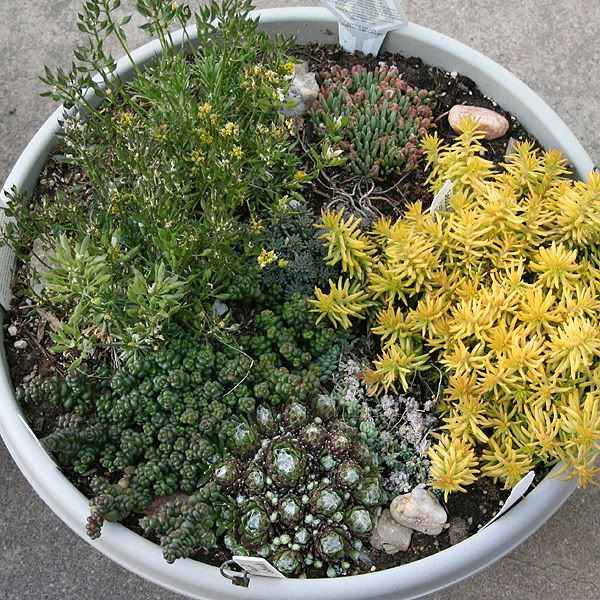
A little over a year ago I posted about some recently acquired hypertufa pots and some plants to put in them. Well, not only did the plants I bought do well, but I went and bought some more pots from Fox Meadow up in Fort Collins, Colorado and then went hog wild buying plants. It didn't help that Timberline Gardens, a local nursery in Arvada, Colorado, has an unbelievably large variety of sedum and sempervivum. This variety, combined with Timberline's discount table where many cool plants can be had for only a $1, cause me to go crazy and buy way more plants than I had pots or gardens for. I guess I'll just have to get more pots and dig up more of the back yard.
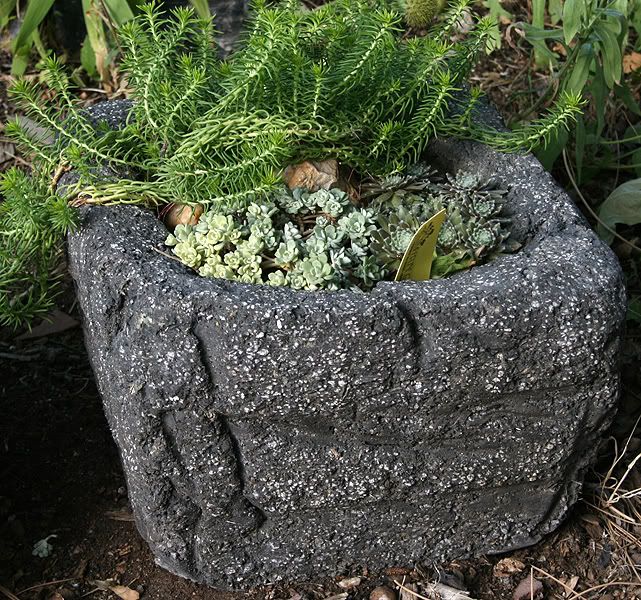
The picture above shows the pot I pictured in the 2009, only all potted up with some sedums, sempervivums, jovibarba and a tiny dwarf ice plant. The pot below is my old, home made hypertufa pot filled with sempervivum Oddity, S. funckii and S. arachnoidium. Click on picture for a much bigger image:
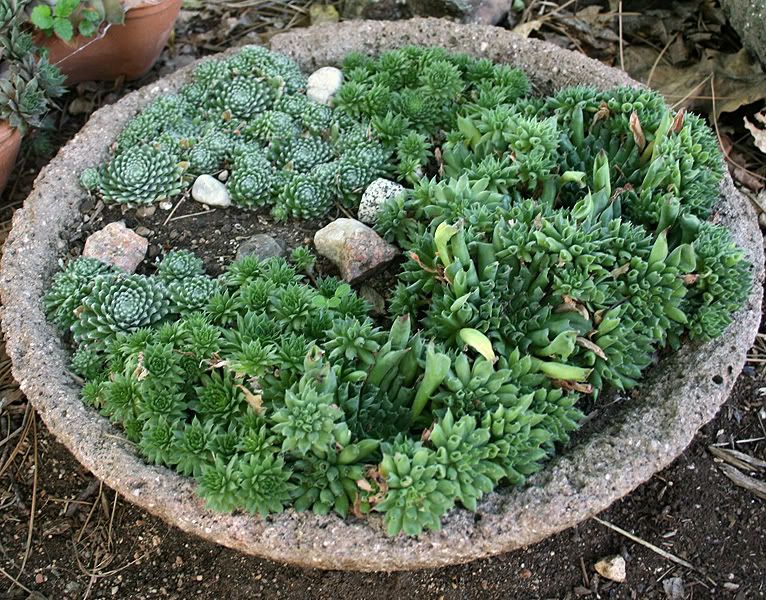
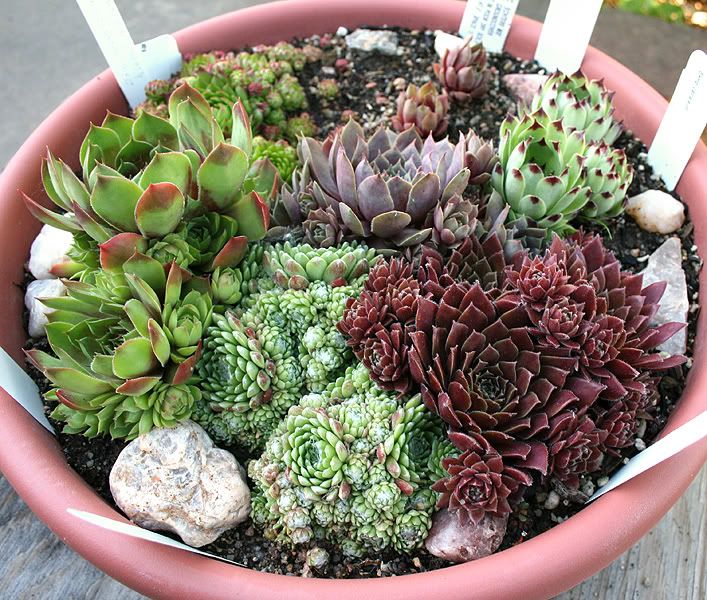
The other new hypertufa pots from Fox Meadow are shown below, all planted up. Click on the pic for a bigger image:
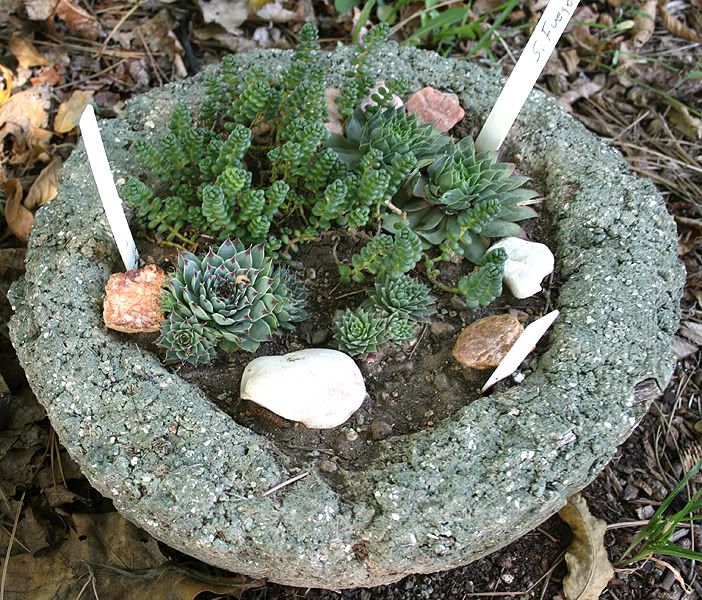

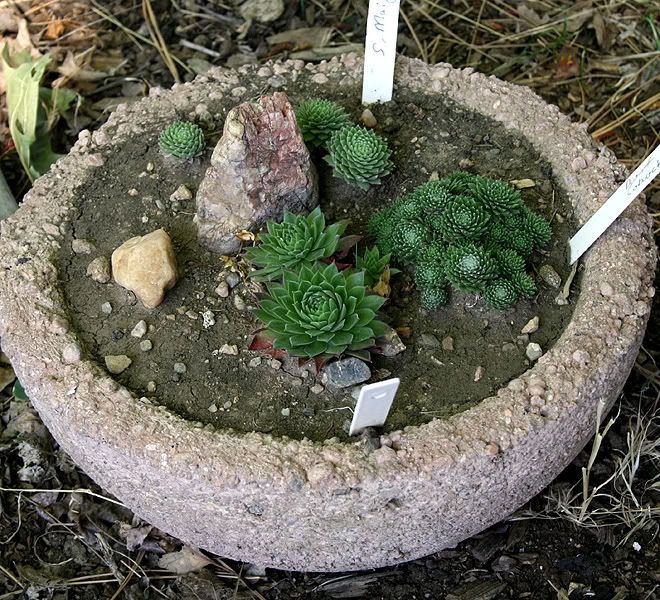
Plus, there's a new pot made from left over Quikcrete and a bit of cement colorant:
And then there faux hypertufa, or as I like to call it, faux faux Tufa since hypertufa is meant to simulate tufa, which is a naturally occurring rock. These pots are made of Styrofoam boxes that have been roughed up and painted with leftover house paint and some acrylics.
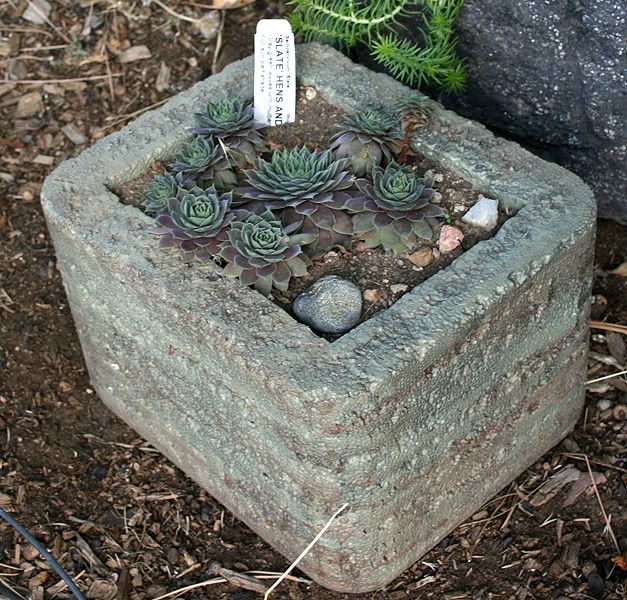
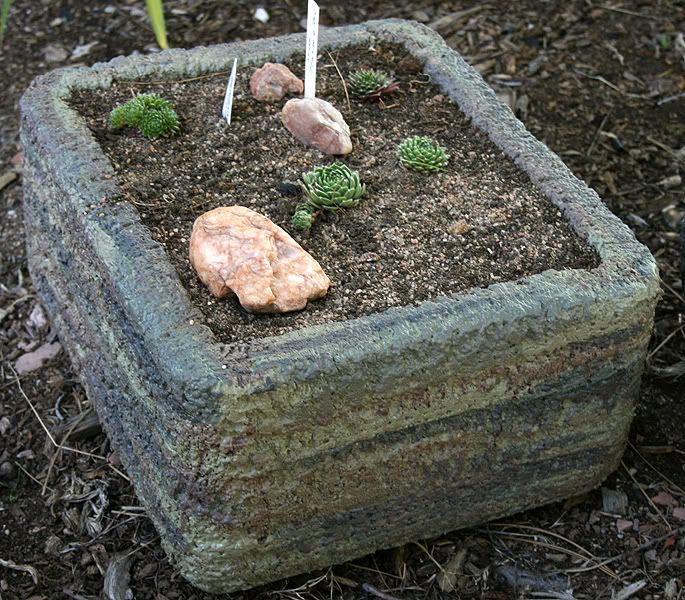
All of the pots, whether they are hypertufa or styrofoam have plenty of drainage holes in the bottom.
The plastic pots planted up with sedums, iceplants and sempervivum in the spring filled in nicely:
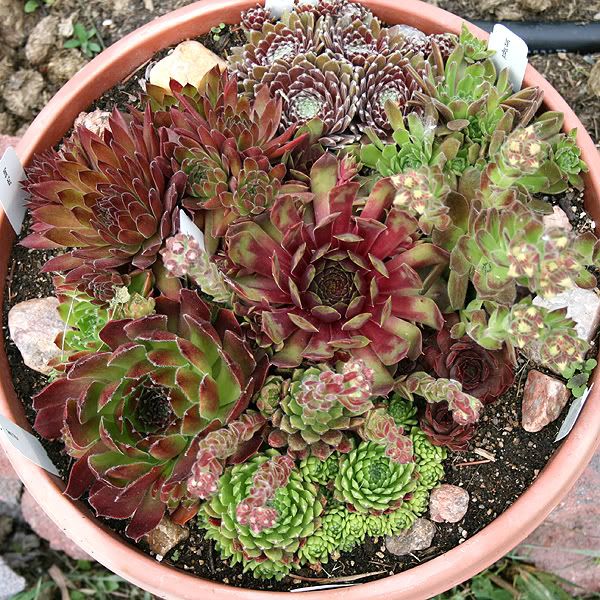
It was fun the see the radical color and appearance change in the sempervivum throughout the year. These pictures show the color change Sempervivum Calcerum Pink Pearl went through from May to July (click for larger pics):
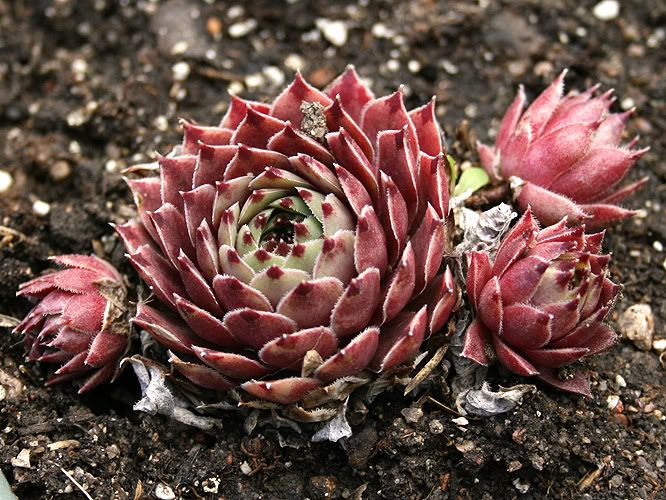
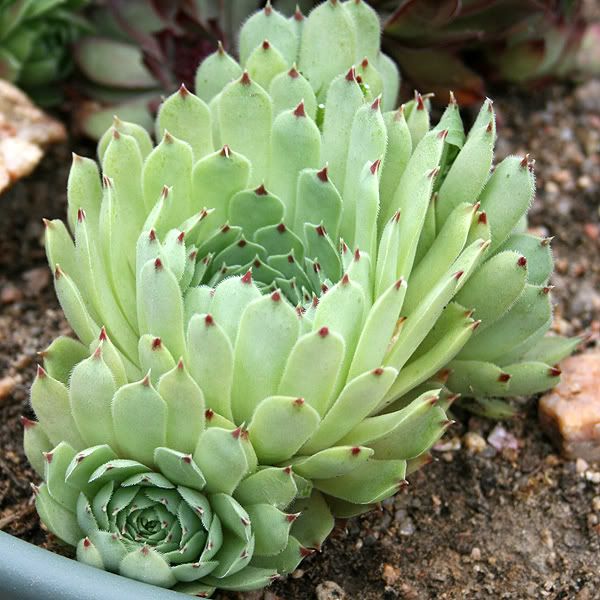
These pictures show the range of colors S. Spherette went through from May to September:

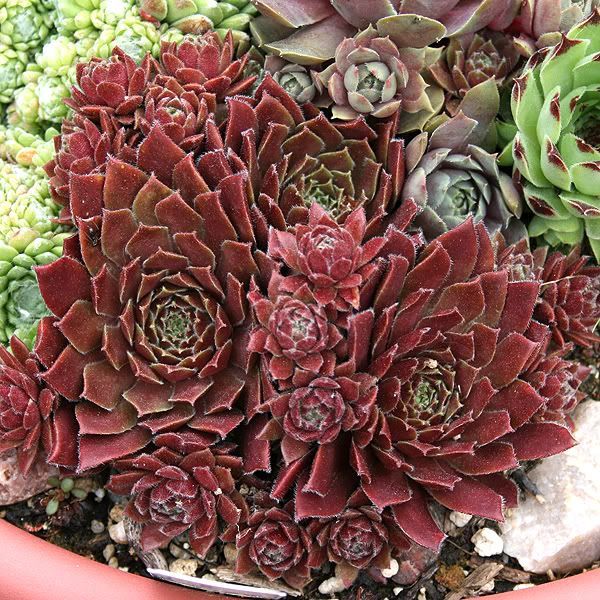
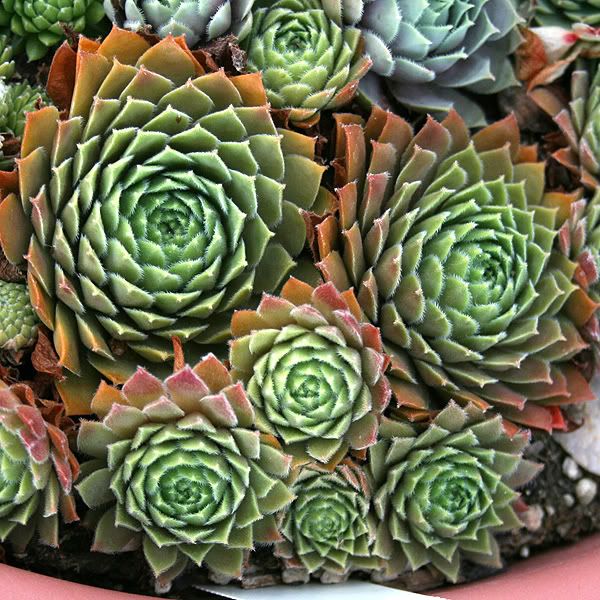
Sempervivum Fuego also undergoes a radical color change. Here it is from April to September:
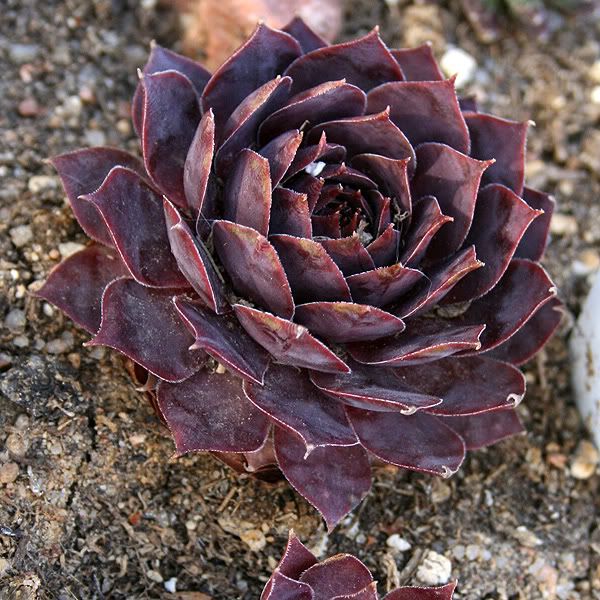

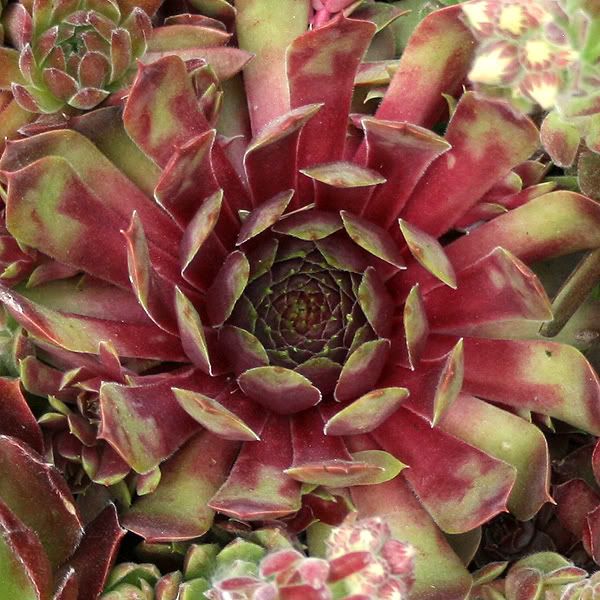
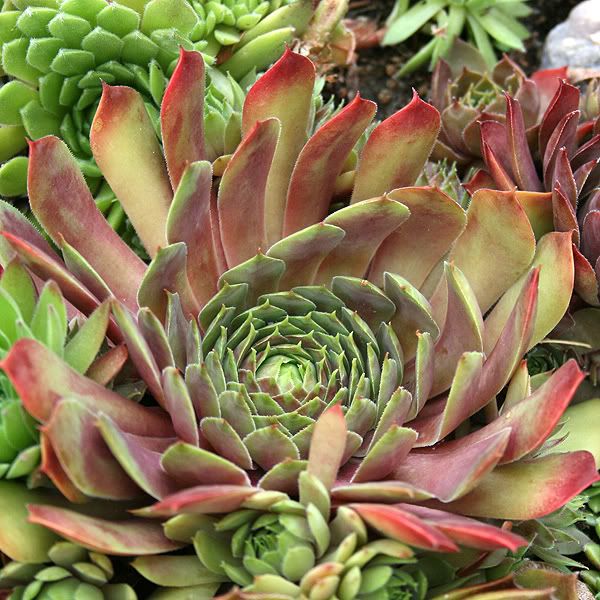
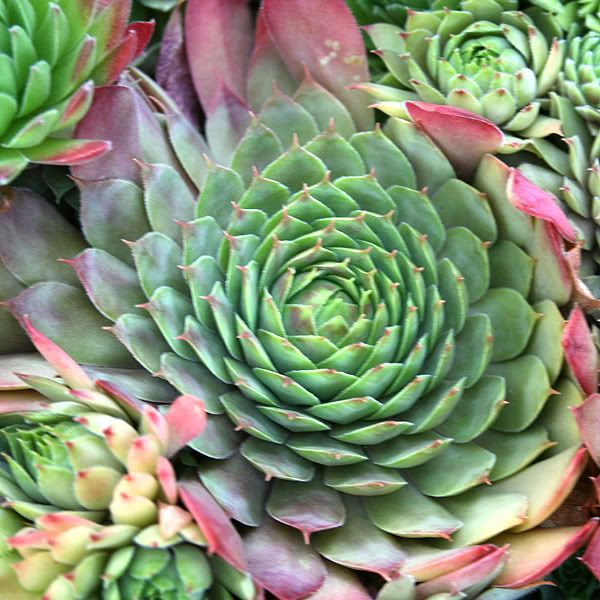
As winter arrived, some became an intense shade of red, while others became more green. Some changed from blue green to purple. Some stayed pretty much the same. I have lots more pictures here.
Subscribe to:
Comments (Atom)


